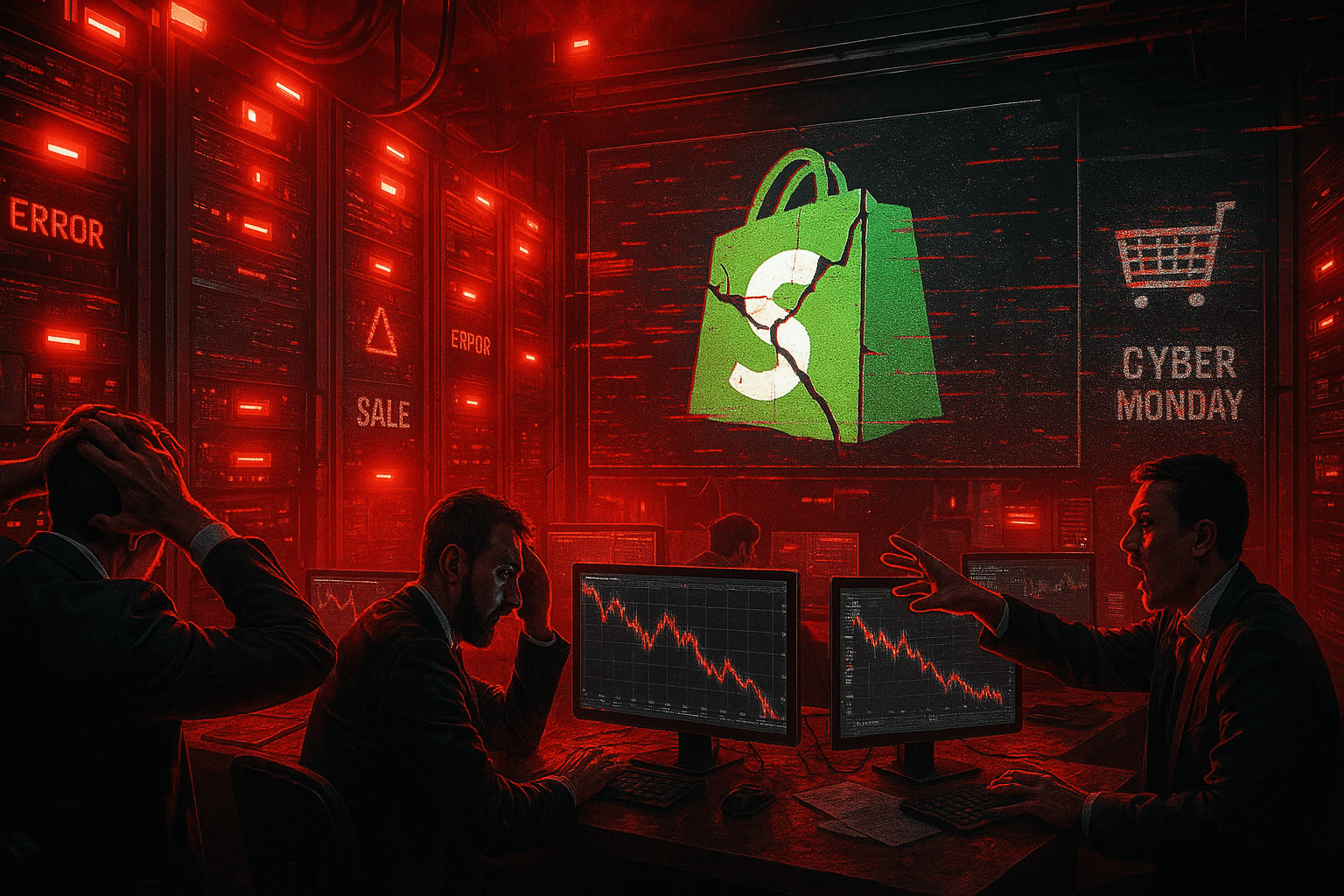
Shopify's Cyber Monday Outage: Trading the Tech Infrastructure Risk
On December 1, 2025, Shopify experienced a significant service disruption during Cyber Monday—one of the most critical days for e-commerce retailers. The outage, which peaked at 11 a.m. EDT with approximately 4,000 user reports according to Downdetector, prevented merchants from processing transactions during what was expected to be a record-breaking $14.2 billion online shopping day. For traders, this incident offers valuable lessons about tech infrastructure risk, platform dependency, and how to position around operational failures in high-growth technology stocks.
The Incident: What Happened and When It Mattered Most
Timing and Impact
The outage occurred during Cyber Monday 2025, when Adobe Analytics predicted consumers would spend a record $14.2 billion online, representing a 6.3% increase from the previous year. This follows Black Friday's record $11.8 billion in online sales, making the holiday shopping season particularly critical for e-commerce platforms.
Key Details:
- Peak Reports: 4,000 outage reports at 11 a.m. EDT
- Affected Systems: Login authentication flow and point-of-sale (POS) systems
- Resolution: Shopify identified and fixed the authentication issue by 2:31 p.m. EDT
- Duration: Approximately 3-4 hours of significant disruption during peak shopping hours
What Shopify Merchants Lost
Shopify powers over 2 million businesses globally, processing billions in transactions. During the outage:
- Merchants couldn't process online transactions
- In-store POS systems were affected
- Inventory management systems were disrupted
- Customer checkout processes failed
For small and medium-sized businesses relying on Shopify, this outage potentially cost thousands in lost sales during their most important revenue day of the year.
Trading Implications: How Platform Outages Affect Stock Prices
Immediate Market Reaction Patterns
Tech infrastructure outages typically trigger predictable market responses:
1. Initial Sell-Off (Minutes to Hours)
- Stock price often drops 2-5% on initial news
- Volume spikes as traders react to headlines
- Options implied volatility increases significantly
2. Recovery Phase (Hours to Days)
- Price recovery depends on:
- Severity and duration of outage
- Financial impact quantification
- Management response and communication
- Competitive response from rivals
3. Long-Term Assessment (Weeks to Months)
- Customer retention rates post-outage
- Revenue impact on next earnings report
- Infrastructure investment announcements
- Market share shifts to competitors
Historical Precedents
Similar outages in tech infrastructure have created trading opportunities:
- AWS Outages (2021): Amazon stock dropped 2.3% but recovered within days as the outage was contained
- Cloudflare Outages (2019): NET stock declined 4% but rebounded as the company demonstrated quick resolution
- Stripe Payment Failures (2020): Private company, but highlighted payment infrastructure fragility
Financial Impact Analysis: Quantifying the Damage
Revenue Loss Calculations
While Shopify hasn't disclosed specific financial impact, we can estimate:
Merchant Revenue Loss:
- Average Shopify merchant processes $50,000-$500,000 annually
- Cyber Monday represents 2-5% of annual revenue for many merchants
- 3-4 hour outage during peak hours = 12-20% of daily revenue lost
- Estimated merchant losses: $50-200 million in aggregate
Shopify's Revenue Impact:
- Transaction fees: 2.9% + 30¢ per transaction
- Subscription revenue: Unaffected (monthly recurring)
- Estimated lost transaction fees: $1.5-6 million
- Potential customer churn: Harder to quantify but potentially significant
Long-Term Financial Implications
1. Customer Retention Risk
- Merchants may explore multi-platform strategies
- Some may switch to competitors (WooCommerce, BigCommerce, Squarespace)
- Enterprise customers may demand service level agreements (SLAs) with penalties
2. Competitive Positioning
- Competitors may use the outage in marketing campaigns
- Enterprise sales cycles may be impacted
- Trust factor becomes a competitive differentiator
3. Infrastructure Investment Requirements
- Shopify may need to accelerate infrastructure spending
- Redundancy and failover systems become priorities
- This could impact near-term margins
Trading Strategies: How to Position Around Tech Outages
Short-Term Trading Opportunities
1. Volatility Trading
-
Options Strategies:
- Buy straddles/strangles before earnings to capture potential revenue impact
- Sell covered calls if holding long positions during uncertain periods
- Consider put spreads if expecting continued weakness
-
Timing: Options premiums typically spike immediately after outage news, then normalize over 1-2 weeks
2. Momentum Plays
- Short-Term Short: If outage extends beyond initial resolution timeline
- Buy the Dip: If outage is quickly resolved and impact appears minimal
- Sector Rotation: Consider e-commerce competitors as beneficiaries
Medium-Term Positioning
1. Earnings Trade Setup
- Monitor next quarterly earnings for:
- Revenue impact from lost transaction fees
- Customer churn metrics
- Infrastructure spending increases
- Management commentary on reliability improvements
2. Competitive Analysis
- Long Competitors: Consider positions in BigCommerce (BIGC), WooCommerce parent Automattic (private), or Squarespace (SQSP)
- Sector ETFs: E-commerce ETFs like ETSY, AMZN, or broader tech infrastructure plays
Risk Management Considerations
1. Position Sizing
- Reduce position sizes by 20-30% if holding through earnings post-outage
- Avoid over-leveraging during high uncertainty periods
- Use stop-losses to protect against extended downtrends
2. Correlation Risk
- Tech infrastructure stocks often move together on reliability concerns
- Diversify across different tech subsectors
- Consider defensive positions in more stable tech segments
The Bigger Picture: Platform Dependency Risk
Infrastructure as a Service (IaaS) Vulnerability
Shopify's outage highlights broader risks in the platform economy:
1. Single Points of Failure
- Modern e-commerce relies on complex, interconnected systems
- Authentication failures can cascade through entire platforms
- Redundancy is expensive but increasingly necessary
2. Scale Challenges
- As platforms grow, infrastructure complexity increases exponentially
- Peak traffic events (like Cyber Monday) stress-test systems
- Many platforms discover weaknesses only under extreme load
3. Regulatory Scrutiny
- Regulators may examine platform reliability requirements
- Potential for mandatory uptime guarantees
- Data protection and consumer rights considerations
Competitive Landscape Implications
E-Commerce Platform Market Share Dynamics:
- Shopify: ~10% of U.S. e-commerce market
- WooCommerce: ~28% (open-source, self-hosted)
- BigCommerce: ~2% (growing enterprise focus)
- Squarespace: ~1% (SMB-focused)
- Custom Solutions: Remainder
Post-Outage Shifts:
- Enterprise customers may demand multi-platform strategies
- SMBs may prioritize reliability over features
- Open-source alternatives may gain appeal
Technical Analysis: Chart Patterns Post-Outage
Typical Price Action
Phase 1: Initial Decline
- Gap down or sharp decline on outage news
- Volume surge (2-3x average)
- Support levels tested
Phase 2: Consolidation
- Price stabilizes as impact becomes clearer
- Lower volume as uncertainty persists
- Range-bound trading
Phase 3: Resolution
- Breakout direction depends on:
- Financial impact severity
- Customer retention
- Competitive response
- Management credibility
Key Technical Levels to Watch
- Support: Previous lows, 200-day moving average
- Resistance: Pre-outage price levels, psychological round numbers
- Volume Confirmation: Breakouts require volume to validate
Investment Thesis: Is This a Buying Opportunity?
Bullish Factors
1. Temporary Nature
- Outage was resolved within hours
- No data breach or security compromise reported
- Core business model remains intact
2. Market Position
- Shopify maintains strong market position
- Network effects create switching costs
- Merchant ecosystem is deeply integrated
3. Growth Trajectory
- E-commerce continues expanding
- International expansion opportunities
- Enterprise segment growth potential
Bearish Factors
1. Trust Erosion
- Merchants may diversify platforms
- Enterprise sales may slow
- Brand reputation impact
2. Competitive Pressure
- Competitors may gain market share
- Price competition intensifies
- Feature differentiation becomes harder
3. Infrastructure Costs
- Required investments may pressure margins
- Capital allocation shifts from growth to reliability
- ROI on infrastructure spending is uncertain
Sector-Wide Implications: E-Commerce Infrastructure Stocks
Companies to Monitor
1. Direct Competitors
- BigCommerce (BIGC): May benefit from Shopify's outage
- Squarespace (SQSP): Alternative for SMB segment
- Wix (WIX): Website builder with e-commerce capabilities
2. Payment Processors
- Stripe (private): Many Shopify merchants use Stripe
- PayPal (PYPL): Alternative payment infrastructure
- Block (SQ): Square's e-commerce tools
3. Cloud Infrastructure
- Amazon Web Services (AMZN): Powers many e-commerce platforms
- Cloudflare (NET): CDN and security services
- Fastly (FSLY): Edge computing infrastructure
Risk Management: Lessons for Tech Stock Investors
Due Diligence Checklist
When investing in platform/Infrastructure-as-a-Service companies:
- Uptime History: Review historical outage frequency and duration
- Redundancy Systems: Understand failover capabilities
- Peak Load Capacity: Assess ability to handle traffic spikes
- Customer Concentration: Evaluate dependency on key merchants
- Competitive Moat: Analyze switching costs and alternatives
Portfolio Construction
Diversification Strategies:
- Avoid over-concentration in single platform stocks
- Balance growth tech with infrastructure stability
- Consider defensive positions in more established platforms
- Maintain cash reserves for opportunistic buying
Conclusion: Trading Infrastructure Reliability
Shopify's Cyber Monday outage serves as a critical reminder that even the most successful tech platforms face operational risks. For traders, this incident offers several key takeaways:
- Outages create volatility, but the long-term impact depends on resolution speed and customer retention
- Platform dependency is a double-edged sword—strong network effects but single points of failure
- Competitive dynamics shift when reliability becomes a differentiator
- Infrastructure investments may pressure margins but are necessary for scale
As e-commerce continues growing and platforms become more critical to business operations, reliability will increasingly separate winners from losers. Traders who understand these dynamics and can assess the true financial and competitive impact of outages will be better positioned to capitalize on both the risks and opportunities they create.
The platform economy is built on trust. When that trust is tested, trading opportunities emerge—but so do fundamental risks that require careful analysis and disciplined risk management.
Source: CBS News - Shopify outage disrupts some merchants on Cyber Monday